

The monograph series Eastern Europe in the Twentieth Century, published by De Gruyter/ Oldenbourg, holds collected volumes emanating from Kolleg conferences and workshops, as well as monographic studies by staff and affiliated researchers.
The four-volume series The Routledge History Handbook of Central and Eastern Europe in the Twentieth Century summarizes the current state in core research fields from the perspective of internationally renowned scholars. Each volume is devoted to one of the Kolleg’s central research areas: Challenges of Modernity,Statehood, Intellectual Horizons and War, Violence and Oppression.
Cultures of History Forum
The Cultures of History Forum is an online platform for actors and researchers in the areas of public history and memory politics to publish critical analyses and reflections about ongoing debates, museum exhibitions or public policy relating to the history of the twentieth century in the countries of the region of Central Southeastern and Eastern Europe.
Staff Publications
Fellow Publications
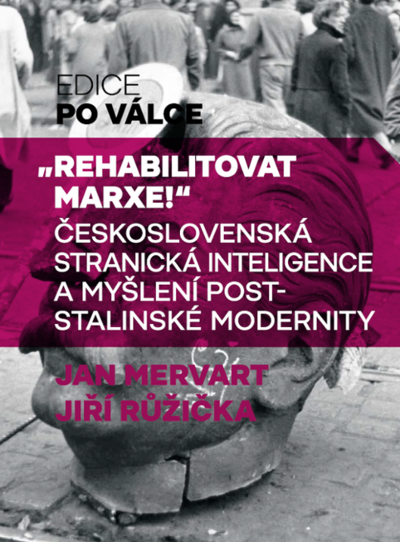
The book is devoted to the thought of the Czechoslovak Communist Party intelligentsia during the post-Stalinist period. The authors focus their attention on the central problems and basic categories from which new variants of socialist modernity were conceptualized. By the second half of the 1950s, it had become increasingly evident that the Stalinist model of building socialism as a specific project of modernization was running out of steam. In light of this reality, the Czechoslovak party intellectuals started to realize that the primary problem they were facing wasn’t the officially announced transition from socialism to communism, but the need to reformulate the entire socialist project. Post-Stalinist intellectuals thus gradually abandoned the schematism of Marxist orthodoxy and started to search for new interpretations of (not only) Marx’s writings that would provide an adequate conceptual framework for the solution of their current-day problems. The motto “Rehabilitate Marx!,” which the authors of this book borrowed to use as the book’s title, meant for post-Stalinist intellectuals not only cleansing Marx and Marxism of its Stalinist residue, but also and perhaps above all proving its philosophical superiority. This book represents an analytical archeology of this historically unsuccessful but, in terms of ideas, very rich and diverse project.
The book is devoted to the thought of the Czechoslovak Communist Party intelligentsia during the post-Stalinist period. The authors focus their attention on the central problems and basic categories from which new variants of socialist modernity were conceptualized. By the second half of the 1950s, it had become increasingly evident that the Stalinist model of building socialism as a specific project of modernization was running out of steam. In light of this reality, the Czechoslovak party intellectuals started to realize that the primary problem they were facing wasn’t the officially announced transition from socialism to communism, but the need to reformulate the entire socialist project. Post-Stalinist intellectuals thus gradually abandoned the schematism of Marxist orthodoxy and started to search for new interpretations of (not only) Marx’s writings that would provide an adequate conceptual framework for the solution of their current-day problems. The motto “Rehabilitate Marx!,” which the authors of this book borrowed to use as the book’s title, meant for post-Stalinist intellectuals not only cleansing Marx and Marxism of its Stalinist residue, but also and perhaps above all proving its philosophical superiority. This book represents an analytical archeology of this historically unsuccessful but, in terms of ideas, very rich and diverse project.
The book is devoted to the thought of the Czechoslovak Communist Party intelligentsia during the post-Stalinist period. The authors focus their attention on the central problems and basic categories from which new variants of socialist modernity were conceptualized. By the second half of the 1950s, it had become increasingly evident that the Stalinist model of building socialism as a specific project of modernization was running out of steam. In light of this reality, the Czechoslovak party intellectuals started to realize that the primary problem they were facing wasn’t the officially announced transition from socialism to communism, but the need to reformulate the entire socialist project. Post-Stalinist intellectuals thus gradually abandoned the schematism of Marxist orthodoxy and started to search for new interpretations of (not only) Marx’s writings that would provide an adequate conceptual framework for the solution of their current-day problems. The motto “Rehabilitate Marx!,” which the authors of this book borrowed to use as the book’s title, meant for post-Stalinist intellectuals not only cleansing Marx and Marxism of its Stalinist residue, but also and perhaps above all proving its philosophical superiority. This book represents an analytical archeology of this historically unsuccessful but, in terms of ideas, very rich and diverse project.