

The monograph series Eastern Europe in the Twentieth Century, published by De Gruyter/ Oldenbourg, holds collected volumes emanating from Kolleg conferences and workshops, as well as monographic studies by staff and affiliated researchers.
The four-volume series The Routledge History Handbook of Central and Eastern Europe in the Twentieth Century summarizes the current state in core research fields from the perspective of internationally renowned scholars. Each volume is devoted to one of the Kolleg’s central research areas: Challenges of Modernity,Statehood, Intellectual Horizons and War, Violence and Oppression.
Cultures of History Forum
The Cultures of History Forum is an online platform for actors and researchers in the areas of public history and memory politics to publish critical analyses and reflections about ongoing debates, museum exhibitions or public policy relating to the history of the twentieth century in the countries of the region of Central Southeastern and Eastern Europe.
Staff Publications
Fellow Publications
Russian and East European Studies
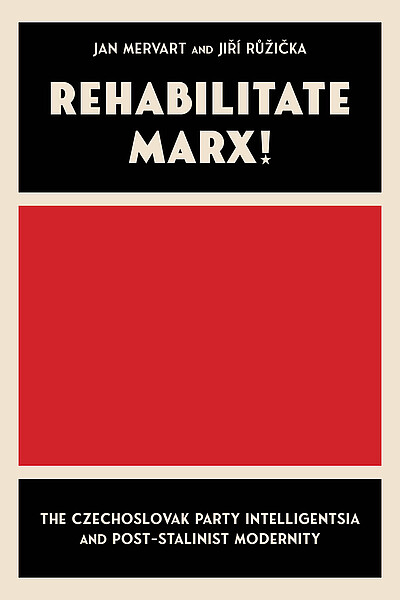
Rehabilitate Marx! conceptualizes new forms of socialist modernity during the post-Stalinist era in the second half of the 1950s and 1960s. After the demise of Stalinism, Czechoslovak intellectuals within the Communist Party realized that the primary challenge they faced wasn’t merely the further development of socialism, which would lead to communism, but that they needed to reformulate the entire socialist project. These intellectuals gradually abandoned the Marxist orthodoxy of their time and began searching for new interpretations of classic Marxist works that would provide an adequate conceptual framework for addressing contemporary problems. Mervart and Růžička present post-Stalinist thought as an autonomous sphere, showing a world of varying socialist visions.
Russian and East European Studies
Rehabilitate Marx! conceptualizes new forms of socialist modernity during the post-Stalinist era in the second half of the 1950s and 1960s. After the demise of Stalinism, Czechoslovak intellectuals within the Communist Party realized that the primary challenge they faced wasn’t merely the further development of socialism, which would lead to communism, but that they needed to reformulate the entire socialist project. These intellectuals gradually abandoned the Marxist orthodoxy of their time and began searching for new interpretations of classic Marxist works that would provide an adequate conceptual framework for addressing contemporary problems. Mervart and Růžička present post-Stalinist thought as an autonomous sphere, showing a world of varying socialist visions.
Russian and East European Studies
Rehabilitate Marx! conceptualizes new forms of socialist modernity during the post-Stalinist era in the second half of the 1950s and 1960s. After the demise of Stalinism, Czechoslovak intellectuals within the Communist Party realized that the primary challenge they faced wasn’t merely the further development of socialism, which would lead to communism, but that they needed to reformulate the entire socialist project. These intellectuals gradually abandoned the Marxist orthodoxy of their time and began searching for new interpretations of classic Marxist works that would provide an adequate conceptual framework for addressing contemporary problems. Mervart and Růžička present post-Stalinist thought as an autonomous sphere, showing a world of varying socialist visions.